


THE V A R I A B L E | April 2000
Presidential Contest Tightens in Colorado
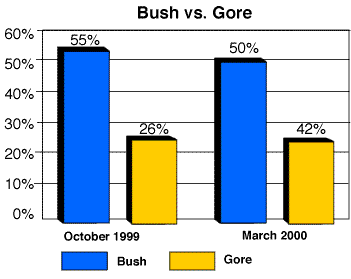 George Bush has a narrow lead over Al Gore in the 2000 presidential election. In the 9KUSA/KOA Radio/ Denver Post presidential primary survey, Bush held an eight percent lead against Gore, down from 29 points last October. This tightening reflects the hard fought Republican primaries, which hurt Bush's image as an even-tempered moderate among independents and swing Democrats. John McCain's independent image and attacks on Bush as a captive of the extreme right were not effective among Republican rank and file, but strongly influenced the broader electorate. For example, while Bush decisively defeated McCain in the poll among Colorado Republicans, McCain in fact beat Gore by 20 points, 54 percent to 34 percent in a hypothetical general election face-off question. McCain's good showing is attributed to his large margin among unaffiliated voters (now numbering more than 900,000 in Colorado, nearly equal to Republican registration) and winning nearly a fourth (23%) of Democratic voters. Bush only wins unaffiliated voters by one percent against Gore, and carries 16 percent of Democrats. Fortunately for Gore, the primary season livened up his dull image and made him appear more pragmatic and moderate against the idealistic and liberal Bill Bradley. Bradley's weaker effort also shortened the duration and impact of negative attacks against Gore. Even with this good fortune Gore is burdened with a higher negative than positive favorability among Coloradans (45% positive to 47% negative), which is partially a reflection of Clinton fatigue.
While Colorado leans Republican in the presidential contest, recent shifts will keep the race close. Unaffiliated voters now hold the balance of power. They are moderate in disposition and react quickly to campaign events. Late issues can move substantial numbers (they helped make the 1998 governors race close in Colorado).
Other battleground groups will be Hispanic voters, whose registration numbers are increasing, and suburban women. Bush hopes to reduce the traditional gaps Republicans face with these constituencies, while Gore will attempt to label Bush as too extreme to be trusted.
Timing is Everything
| . | ||||||||||||||
Ciruli Associates, 2000 |
While the early collapse of the contests dampened Colorado turnout (only 10% of Democrats and 19% of Republicans voted), it most likely did not change the outcome. A 9KUSA/KOA NewsRadio/Denver Post poll conducted the weekend before the primary showed Gore and Bush with commanding leads in their respective parties.
The only states to join Colorado on March 10, Utah and Wyoming, also affirmed Bush and Gore with little participation.
It remains to be seen if current efforts to discourage front-loading the primary season in favor of equally distributing primary dates continue much beyond the August conventions. Reform moods among party officials have historically been short-lived.
Owens Top State Politician
After slightly more than a year in office, Governor Bill Owens' favorability rating exceeds that of his popular predecessor, Roy Romer. Seventy-nine percent of Republican voters rated him favorably, as did half of Democrat voters. Owens' popularity has risen dramatically as he has become better known to Colorado voters: His favorability has grown from 32 percent prior to his election in October 1998, to 38 percent in February of 1999, to its current level of 63 percent.
 Several factors have contributed to the governor's improved position. Perhaps most importantly, he focused his efforts on a few key issues and kept his top two promises: to build roads and cut taxes. Along with gaining legislative approval for a 1999 tax cut, he convinced voters to support a multi-billion dollar bond program to build new roads.
Also, Owens has defied easy labeling. After his razor-thin victory in 1998 many voters expected controversial conservative legislation and rhetoric. But voters, especially liberals and moderates, have been surprised by the governor's avoidance of most controversial social issues, as well as his advocacy of modest gun control and smart growth policies. Even his aggressive education reforms have gained support because they eschew vouchers and provide more money for increased accountability.
Finally, for many voters who ignore politics, Owens' criticism of John and Patsy Ramsey raised the governor's profile while giving voice to public outrage regarding the failure to find the killer or killers.
Owens is now Colorado's leading political figure, dominating both the policy process and his party.
Regulate Gun Sales— Don't Outlaw
Gun show owners are among Colorado voters' least favored groups. Voters want gun show loopholes closed. Eighty-three percent believe a "mandatory background check for all gun purchases at gun shows" should be conducted. That figure includes 72 percent support from Republicans. Voters are unsympathetic to the argument that gun show regulations could hurt business. A carefully crafted ballot initiative requiring mandatory checks would likely pass.
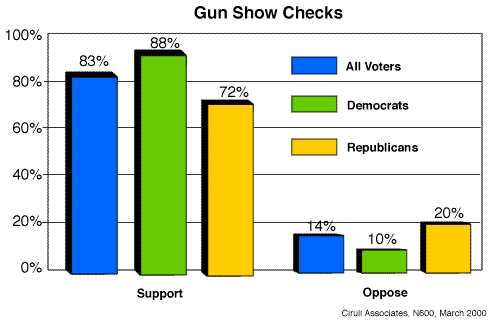
However, there are limits to public support for gun regulations. Voters are sensitive to the rights of law-abiding citizens to own a gun. They believe the 2nd Amendment covers individuals and not just state militias. Further they believe gun ownership is a right protected by the constitution not just a privilege "under the complete control of the states" (right protected by constitution, 59% versus privilege controlled by states, 31%). Protecting children and restricting criminals from gun access are acceptable reasons for regulation. Schemes that can be described as outlawing sales, universal registration, and confiscation will engender a backlash.
In addition, while only 14 percent of the public opposes gun show regulation, they feel intensely about the issue, and many are activists. Gun control has replaced abortion as the most polarizing issue in the November 2000 election.
School Reform Strongly Supported
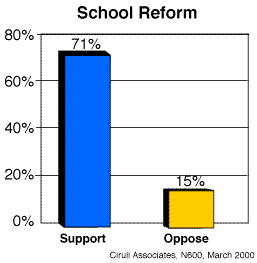 Colorado voters believe it's time to start grading their public schools — and failing the worst performers. Although Colorado voters have rejected vouchers on two occasions, they appear ready for serious change in the K-12 system. The education establishment's defense of the status quo is losing ground with these voters.
Question: Do you support or oppose grading elementary and secondary schools A to F based on success in improving student performance? Schools receiving an F would have to implement new management and new educational programs. Support or Oppose
©2000 Ciruli Associates. All rights reserved